The "digital arrest" scam: how it works and how to shut it down
A fake officer on a video call, a fake court hearing and a "refundable" transfer. Here is how the digital arrest scam works, and the one-minute response that stops it.
By Shashi Kumar ·
It starts with something boring. A recorded voice says a parcel in your name has been stopped. Or a "TRAI officer" says your number will be cut off in two hours over complaints.
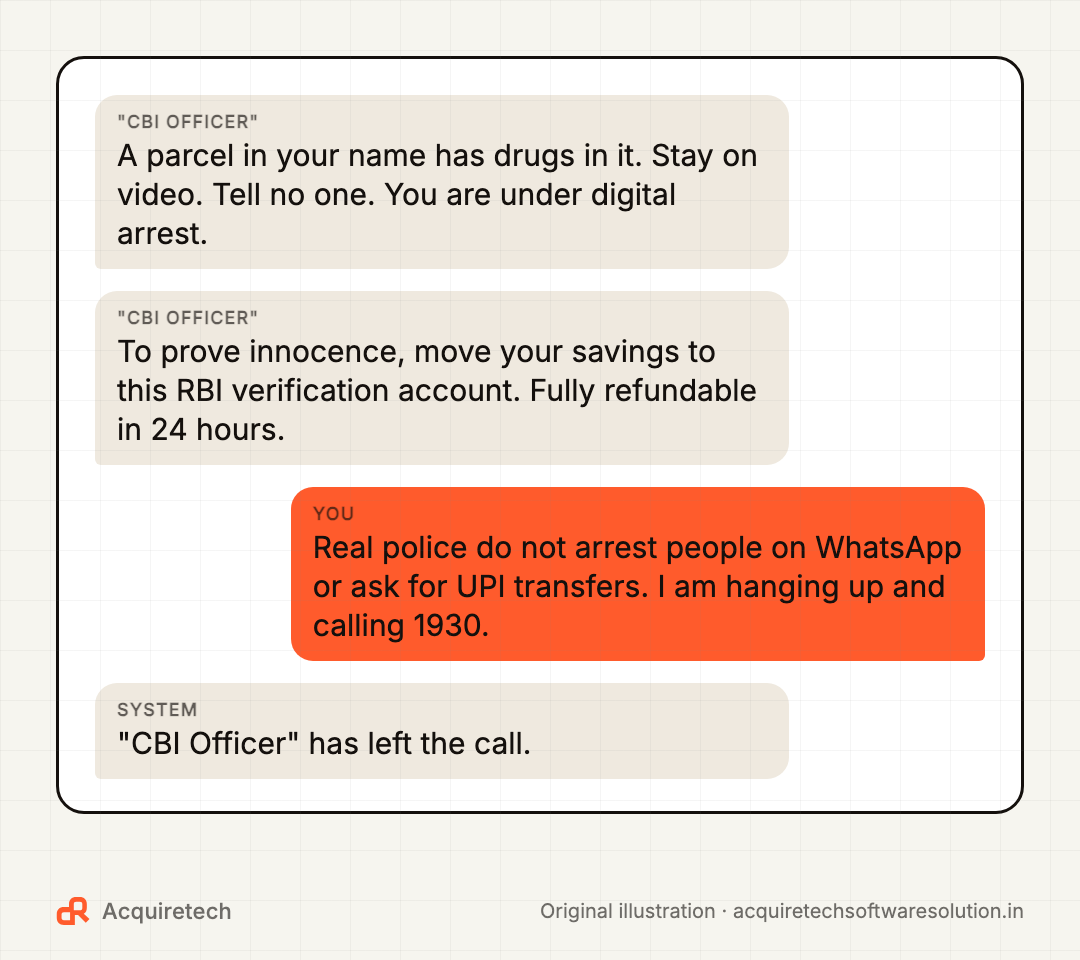
Twenty minutes later you are on a video call with a uniformed man in what looks like a police station. He says your Aadhaar is linked to money laundering. He says you are now under "digital arrest", you must keep the camera on, and you must not tell anyone, including your own family.
None of this is real. There is no such thing as a digital arrest. But the fear is real, and so are the losses. Between 1 January and 31 August 2026, more than 21,900 digital arrest complaints involving over ₹647 crore were registered across India, according to a status report the Ministry of Home Affairs and I4C filed in the Supreme Court, as reported by the Free Press Journal on 23 October 2026.
Here is how the scam runs, why it works on smart people, and the short response that shuts it down.
How big the problem is
I4C data reported by ThePrint in February 2026 shows 1,23,672 digital arrest cases in 2024 with more than ₹1,900 crore lost, the peak so far. Complaints have fallen since, though published 2025 figures differ between reports.
Individual losses have not shrunk. Cases running into crores keep appearing, and the Supreme Court, which took up the issue on its own in October 2025, has directed the CBI to investigate cases involving ₹10 crore or more.
The government also blocks the tools: in March 2025 the Home Ministry said I4C had blocked more than 3,962 Skype IDs and 83,668 WhatsApp accounts used for digital arrest. Scammers simply make new ones, so your own reaction matters more than any block list.
How the scam works, step by step
The best way to see the playbook is a real case. In January 2026, ThePrint reconstructed how a retired doctor couple in Delhi's Greater Kailash lost ₹14.85 crore over roughly two weeks. Almost every digital arrest follows the same stages.
1. The hook
A call claims to be from a courier company, customs, your bank or TRAI. In the Delhi case, the caller said the victim's number would be disconnected over obscene content and 25 complaints. The only goal is to make you anxious.
2. The handover to an "officer"
The call is "transferred" to the police, CBI, ED, NCB or customs. The charge is always serious: drugs in a parcel, money laundering, a SIM used by terrorists. In Delhi, the call moved to video with a man calling himself an IPS officer from a Mumbai police station.
3. The props
Uniforms, logos, a station backdrop, official-looking warrants and "RBI" letters on WhatsApp. They may already know your name or Aadhaar digits from leaked data, which makes it all feel legitimate.
4. The isolation
The matter is "confidential", telling anyone will make things worse, and you must stay on camera. When the Delhi couple's driver walked in, the scammers insisted it be kept secret. Isolation is the whole point: nobody gets a chance to say "this sounds fake".
5. The fake court
Some gangs stage a virtual "hearing". The Delhi couple appeared before a man posing as a Supreme Court judge. It is theatre designed to make the next request feel like a court order.
6. The "verification" transfer
You are told to break fixed deposits or sell mutual funds and move the money to a "safe" or "RBI verification" account, refundable once you are cleared. If the bank asks, you are coached to call it a loan to a friend. The Delhi couple made eight transfers.
7. The final squeeze, then silence
There is always one more payment to "close the case". Then the officers vanish and the money is already split across mule accounts.
Why it works on smart people
Victims include doctors, engineers, retired officers and students. The scam does not target your knowledge; it targets your nervous system.
- Authority. Most of us were taught to cooperate with police, not argue.
- Fear and shame. Drugs, pornography, terror funding: accusations people are too embarrassed to discuss.
- Time pressure. Decisions forced in minutes, with arrest threatened "tonight".
- Isolation. The constant video call removes the one thing that would save you: a second opinion.
- Sunk cost. After the first transfer, each new payment feels like the way to get the earlier money back.
Key point: If someone on a call is working hard to stop you from talking to your family, your bank or your local police station, you already have your answer.
The one rule to remember
No police force, CBI, ED, customs, TRAI or court in India arrests anyone over a video call, keeps a person "under watch" on camera, or asks them to transfer money to prove their innocence. On 27 October 2024, Prime Minister Narendra Modi said on Mann Ki Baat: "No investigative agency will ever contact you by phone or video call for enquiries," as reported by The Week. His three steps were simple: stop, think, take action.
What to do, minute by minute
If the call is happening right now
- Hang up. You owe a stranger no polite ending. Do not share your screen, install apps or show ID on camera.
- Talk to someone you trust. Saying the story out loud usually breaks the spell.
- Verify independently. If genuinely worried, call your local police station on a number you find yourself, or dial 112.
- Report the number. Use Chakshu on the Sanchar Saathi portal to report suspected fraud calls, SMS and WhatsApp messages, including impersonation of government officials.
If money has already gone
- Call 1930 immediately, or file a complaint at cybercrime.gov.in. Speed matters more than anything else. A Home Ministry official told ThePrint: "There is a golden hour, and if the money is blocked through prompt action, it can be saved." Try to report within the first hour.
- Call your bank's fraud line and ask them to freeze or flag the transfers.
- Keep everything. Transaction IDs (UTR numbers), screenshots of chats, the numbers and IDs used, any "documents" they sent.
- Do not pay anyone who promises recovery. "Recovery agents" who contact victims are often the same gang, or a second one.
A two-minute script for your parents
Older parents are a favourite target: savings in fixed deposits, respect for authority, often living alone. Have this conversation this week, in the language they are most comfortable in.
"Ma, Papa, one thing. If anyone calls saying they are police, CBI, customs or a courier, and says there is a case against you, just cut the call. Real police never arrest anyone on a video call and never ask for money to be transferred. Even if they know your name and Aadhaar number. Even if they say don't tell anyone. Especially then. Call me first, any time, day or night. If money has already gone, call 1930 straight away. You will never be in trouble with me for asking."
Then make it practical:
- Save 1930 in their phone as "Cyber Fraud Helpline".
- Agree that any call about police, courts or blocked accounts gets a call to you first.
- Ask their bank about lower daily transfer limits if large transfers are rare for them.
- Repeat the conversation every few months. Scripts change; the rule does not.
Frequently asked questions
Is "digital arrest" a real legal procedure in India?
No. There is no provision in Indian law for arresting someone over a video call or keeping them under watch on camera. Anyone claiming to place you under digital arrest is running a scam.
Can the police or CBI contact me on WhatsApp video?
No real agency will investigate you over a WhatsApp or Skype video call or ask you to stay on camera. If you are worried a case is real, hang up and call your local police station on a number you find yourself, or dial 112.
What should I do if I have already paid a digital arrest scammer?
Call the national cyber crime helpline 1930 immediately, or file a complaint at cybercrime.gov.in, then call your bank's fraud line. Reporting within the first hour gives the best chance of blocking the money before it moves.
What is Chakshu and when should I use it?
Chakshu is a facility on the Department of Telecommunications' Sanchar Saathi portal for reporting suspected fraud calls, SMS and WhatsApp messages. Use it to report the number that called you; if you have lost money, report on 1930 or cybercrime.gov.in instead.
Why do educated people fall for digital arrest scams?
The scam relies on fear, authority, time pressure and isolation, not on ignorance. Breaking the isolation by hanging up and talking to someone is the most reliable way out.
The short version
Hang up. Tell someone. Call 1930 if money moved. The scam depends on you doing the opposite.
The same fake-authority playbook shows up in fake job offers that ask for fees and AI voice-clone calls pretending to be family, and a few WhatsApp privacy settings are worth changing today. Share this page with whoever in your family answers every unknown number.
Sources and further reading
- Digital Arrest Fraud: Over 21,900 Complaints Involving ₹647 Crore Registered In 2026, Centre Tells Supreme Court · Free Press Journal · 2026-10-23
- After 465% spike in 2024, MHA data shows digital arrest scams are on a decline in India · ThePrint · 2026-02-18
- 'Summons to Mumbai & SC hearing': How GK-2 couple lost Rs 14.85 cr to an elaborate cyber con · ThePrint · 2026-01-11
- Incidents of Digital Arrest · Press Information Bureau (Ministry of Home Affairs) · 2025-03-25
- Modi raises 'digital arrest' scam in Mann ki Baat: 'Lakhs of bank accounts blocked', says PM · The Week · 2024-10-27
- Chakshu: Report Suspected Fraud Communication · Sanchar Saathi, Department of Telecommunications · 2026-11-09
- National Cyber Crime Reporting Portal · Indian Cyber Crime Coordination Centre (I4C), Ministry of Home Affairs · 2026-11-09
Contact Acquiretech Software Solution: info@acquiretechsoftwaresolution.in · WhatsApp +91 80786 33912 · Send an enquiry