"AI slop", explained: why it is everywhere and how to spot it
Two dictionaries crowned it, a tech CEO asked us to stop saying it, and your feed is full of it. Here is what AI slop is, who profits, and how to spot it in ten seconds.
By Shashi Kumar ·
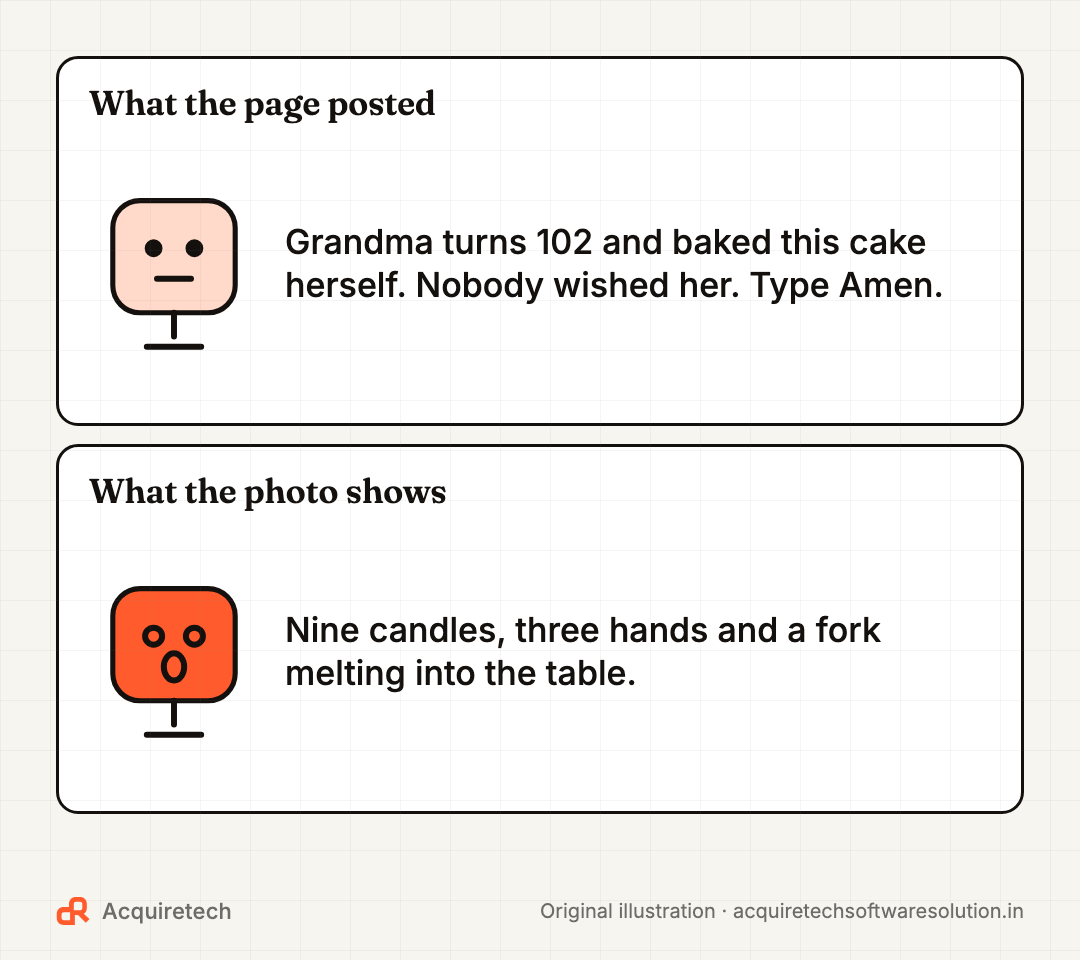
You have seen it even if you have never named it. The shrimp-pink sunset that is slightly too perfect. The video of a monkey in a tragic soap opera, part 47. The recipe blog that takes 1,200 words to say nothing, then gets the oven temperature wrong. The "grandma's 102nd birthday" photo where the cake has nine candles and the fork is melting.
That is AI slop. Between 2024 and 2026 it went from tech slang to word of the year to a stated priority in YouTube's annual letter. Here is what the word means, why slop is so profitable, what platforms are doing about it, and how to spot it in a few seconds.
What does "AI slop" mean?
AI slop is low-quality content made cheaply and in bulk with generative AI, usually to farm attention rather than to inform or entertain anyone in particular. The key ideas are low effort, high volume and unrequested.
The Macquarie Dictionary defines it as "low-quality content created by generative AI, often containing errors, and not requested by the user." Not all AI content is slop, in the same way that not all email is spam. A useful AI-assisted guide that a human checked is not slop. A thousand auto-generated pages written to catch search clicks are.
Where did the term come from?
"Slop" for unwanted AI output circulated in online tech communities before it went mainstream. On 8 May 2024, developer Simon Willison wrote a widely shared post arguing it should become the standard name, like spam. He described slop as AI content "mindlessly generated and thrust upon someone who didn't ask for it," and he credited others for the usage (Simon Willison).
The dictionaries made it official
- Macquarie Dictionary (Australia) named "AI slop" its 2025 Word of the Year in late November 2025, picked by both its committee and the public.
- Merriam-Webster chose "slop" as its 2025 Word of the Year on 15 December 2025, defining it as "digital content of low quality that is produced usually in quantity by means of artificial intelligence," the AP reported.
- By 2026, "slop" had become a suffix. On 3 November 2026, Collins added "friendslop", a low-budget indie video game "played among friends," to its list of notable new words, AP reported.
The word got a famous boost in January 2026, when Microsoft's CEO asked the industry to move past "slop" arguments and the internet replied with "Microslop" (we cover that in the biggest tech memes of 2026).
Why AI slop floods your feed
Slop is not an accident. It is a business model with three ingredients.
1. It is almost free to make. One person with AI tools can produce dozens of images, videos or articles a day. Even if each earns very little, the volume adds up.
2. Platforms pay for attention. Video platforms share ad revenue with creators, social networks run creator bonus schemes, and websites earn from display ads on every page view. A feed that rewards watch time and shares will reward whatever captures watch time and shares.
3. Emotion beats quality. The most common slop formats are built to trigger a reaction: a tragic animal, a heroic child, a lonely elderly person "nobody wished". Every "Amen" or "Happy birthday" comment tells the algorithm to show it to more people.
The scale is real. In a study of data from October 2025, video-editing company Kapwing set up a fresh YouTube account and found that 104 of the first 500 Shorts it was shown (21%) were low-quality AI videos (Kapwing). The most-viewed slop channel it identified globally was India's Bandar Apna Dost, with about 2.07 billion views and estimated annual earnings of around $4.25 million, MediaNama reported. That one data point explains the whole industry.
How platforms are fighting back (as of 9 November 2026)
| Platform | What changed | When |
|---|---|---|
| YouTube | Mass-produced, repetitive content ineligible for ad revenue; CEO named cutting "low quality AI content" a priority | July 2025; January 2026 |
| Less reach and no monetisation for repeated unoriginal reposts | July 2025 | |
| "AI modified" labels and a "see fewer" option | April 2025 | |
| TikTok | A slider to see more or less AI content, plus invisible watermarks | November 2025 |
| Google Search | Spam policy covers mass AI pages; four spam updates so far in 2026 | Ongoing |
YouTube. From 15 July 2025, mass-produced or repetitive content could no longer earn money in the Partner Program, though YouTube said it still welcomes creators who use AI tools to enhance their storytelling, CNBC reported. In his January 2026 letter, CEO Neal Mohan pledged to work "to reduce the spread of low quality AI content," and some big slop channels disappeared, Tubefilter reported.
Meta. In July 2025 Meta said it had removed about 10 million impersonator profiles in the first half of the year and would cut reach and monetisation for accounts that repeatedly repost others' content without meaningful changes (same CNBC report).
Pinterest. It began labelling AI-modified images and announced a "see fewer" option for AI Pins in categories like beauty and art (TechCrunch).
TikTok. In November 2025 it began rolling out an AI-content slider under Settings, Content Preferences, Manage Topics, and started testing invisible watermarks on content made with its own AI tools (TechCrunch).
Google Search. Google's spam policies list "using generative AI tools or other similar tools to generate many pages without adding value for users" as scaled content abuse. Its status dashboard records spam updates starting 24 March, 24 June, 18 August and 24 September 2026.
None of this has made slop disappear. Platforms reduce rewards and add labels; the economics still favour volume.
How to spot AI slop: the checklist
No single tell is reliable any more. Hands and text have improved a lot. Stack several signals instead.
Spot-the-slop checklist
- The account: new page, generic name, dozens of posts a day, all in the same style. That pattern is more telling than any single image.
- The ask: "Type Amen", "Nobody wished him", "Share if you agree". Engagement bait is the business model, not a coincidence.
- The details (images): zoom into hands, cutlery, jewellery, background text and signs. Look for melting objects, extra fingers or letters that are not quite letters.
- The physics (videos): objects that morph between frames, skin that looks airbrushed, very short clips stitched together, a flat AI voiceover.
- The source: run a reverse image search. Real news photos usually trace back to a photographer or outlet; slop traces back to more slop.
- The substance (articles): no named author, no first-hand detail, generic intros, confident statistics without links, quotes you cannot find anywhere else.
- The credentials: some AI tools now embed provenance data. Google's Gemini app can check images for Google's SynthID watermark, but only for content made or edited with Google AI (Google). A clean result does not prove something is real.
If three or more boxes tick, scroll on. And never send money, share personal details or forward "urgent" claims based on content that ticks any of them. Deepfakes use the same tricks with higher stakes, as we explain in our guide to the viral AI fails of 2025 and 2026.
How businesses can avoid becoming slop
If you run a business, the risk is not only seeing slop. It is accidentally publishing it, and being treated like it by customers and search engines. Google's spam policy targets unhelpful mass content "no matter how it's created."
- Use AI for drafts, not for the final word. A human who knows the subject should edit, fact-check and add what only you know.
- Add first-hand proof. Your own photos, real prices you have checked, a local detail, a customer question you actually received.
- Publish fewer, better pages. Ten genuinely useful pages beat two hundred thin ones, especially for a new site. Our guide to SEO for a small business website in its first 90 days shows how.
- Put a name on it. A real author or business owner, with a way to get in touch, signals that someone stands behind the content.
- Build a review step into your AI workflow. We explain how in designing AI workflows with human review.
Frequently asked questions
What is AI slop in simple words?
AI slop is cheap, low-quality content mass-produced with AI tools, usually to grab clicks, views or ad money. Think repetitive videos, fake heart-warming photos and empty articles nobody asked for.
Who coined the term "AI slop"?
Nobody can be credited with inventing it. The word was used in online tech communities before developer Simon Willison's May 2024 blog post helped popularise it as the name for unwanted AI-generated content.
Was "slop" really a word of the year?
Yes. Merriam-Webster named "slop" its 2025 Word of the Year in December 2025, and Australia's Macquarie Dictionary chose "AI slop" for 2025 in November 2025.
Is all AI-generated content slop?
No. Slop is defined by low effort, high volume and low value, not by the tool. AI-assisted content that a knowledgeable human has checked and improved can be genuinely useful.
How can I see less AI slop on social media?
Use the controls platforms now offer, such as TikTok's AI-content slider and Pinterest's "see fewer" option, mark bait posts as not interesting, and unfollow pages that post in bulk. Avoid commenting on bait, because comments boost reach.
The bottom line
AI slop exists because attention pays and AI makes content nearly free. Platforms are slowly cutting the payouts and adding labels, but the best filter is still you: check the account, the ask, the details and the source.
For businesses, the lesson is the reverse. In a feed full of slop, specific, human, checked content stands out more than ever. If you want help building a website or content workflow that uses AI without sounding like it, talk to us.
Sources and further reading
- Slop is the new name for unwanted AI-generated content · Simon Willison · 2024-05-08
- 'AI slop': Macquarie Dictionary's Word of the Year is a sad reflection of modern anxieties · Euronews · 2025-11-26
- Merriam-Webster's 2025 word of the year is 'slop.' Here's why · Associated Press via KFVS12 · 2025-12-15
- Collins Dictionary chooses 'mogging' as its 2026 word of the year · ABC News (AP) · 2026-11-03
- AI Slop Report: The Global Rise of Low-Quality AI Videos · Kapwing · 2025-11-28
- AI Slop Videos Dominating 33% YouTube Feeds, Algorithmic Recommendations Behind It: Study · MediaNama · 2025-12-29
- Meta removes 10 million Facebook profiles in effort to combat spam · CNBC via NBC DFW · 2025-07-14
- YouTube has banned some slop channels. Can it stay ahead of "low quality AI content"? · Tubefilter · 2026-01-29
- Pinterest launches new tools to fight AI slop · TechCrunch · 2025-04-30
- TikTok will let you choose how much AI-generated content you want to see · TechCrunch · 2025-11-18
- Spam policies for Google web search · Google Search Central · 2026-11-09
- History for Ranking | Google Search Status Dashboard · Google · 2026-11-09
- How we're bringing AI image verification to the Gemini app · Google · 2025-11-20
Contact Acquiretech Software Solution: info@acquiretechsoftwaresolution.in · WhatsApp +91 80786 33912 · Send an enquiry