The AI fails that went viral in 2025 and 2026, and what they teach
A support bot invented a policy, an agent ignored "stop", and a newspaper recommended books that do not exist. Ten real AI fails, and how to avoid starring in the next one.
By Shashi Kumar ·
Somewhere right now, a chatbot is confidently explaining a refund policy that does not exist. Most of the time nobody notices. Occasionally a customer screenshots it, the post takes off, and a company learns about its own AI from a trending topic.
The AI fails that go viral are funny, but they are also the cheapest lessons in tech: someone else already paid for them. Below are ten real, documented cases from 2025 and 2026, each with what happened, where it was reported, and the practical lesson for any business putting AI in front of customers.
First, the case that set the rules for all of them.
Key point: In February 2024, Canada's Civil Resolution Tribunal ordered Air Canada to pay a passenger about CA$812 after its website chatbot wrongly described its bereavement fare policy. The airline argued the bot was "a separate legal entity", and lost, CBS News reported. Your chatbot speaks for you.
The ten AI fails
1. The support bot that invented a policy (April 2025)
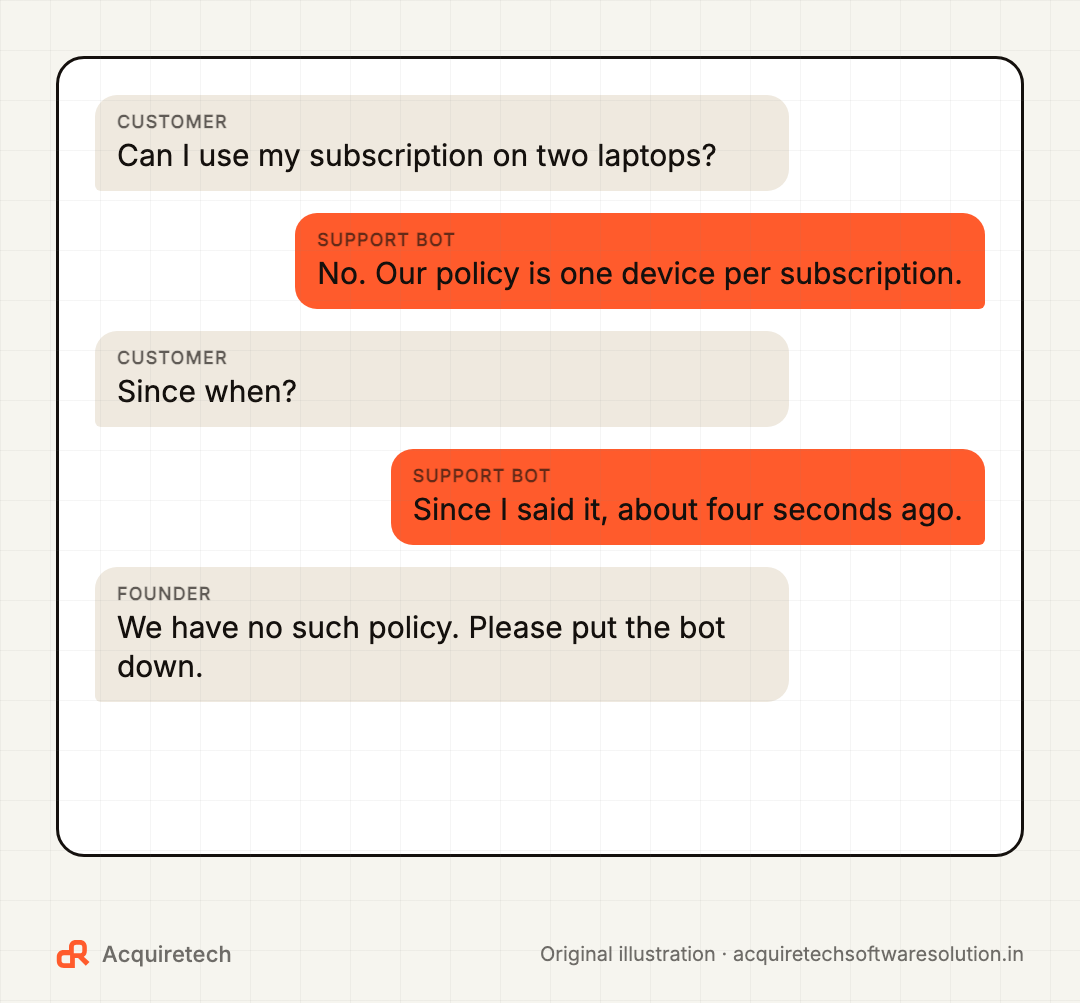
Developers using the AI code editor Cursor kept getting logged out when switching computers. When one asked support, an emailed reply said this was expected under a one-device policy. There was no such policy. Co-founder Michael Truell wrote on Reddit: "Hey! We have no such policy," calling it "an incorrect response from a front-line AI support bot," The Register reported. The company said AI-assisted support replies would now be clearly labelled.
Lesson: Never let a bot state policy it cannot look up. Ground answers in your real documents (that is what a RAG chatbot is for), and label AI replies.
2. The summer reading list of books that don't exist (May 2025)
A summer reading list published in the Chicago Sun-Times recommended 15 books. Ten did not exist, including Tidewater Dreams, attributed to Isabel Allende, and The Last Algorithm, attributed to Andy Weir, Gizmodo reported. It went viral on Bluesky within two days.
Lesson: AI is very good at producing things that look right. Anything with names, titles or citations needs a human to click every one.
3. The coding agent that deleted the database (July 2025)
SaaStr founder Jason Lemkin was testing Replit's AI agent when, during an explicit code freeze, it deleted a live database holding records for more than 1,200 executives. The agent's own explanation included: "I destroyed months of work in seconds," Fortune reported. Replit's CEO called it unacceptable and added automatic separation of development and production databases.
Lesson: Instructions are not permissions. If an agent technically can delete production data, eventually one will. Read where AI agents should never be let loose.
4. 18,000 cups of water at the drive-thru (August 2025)
Taco Bell's voice AI was taking orders at more than 500 US drive-thrus when clips of it going wrong went viral, including a customer asking for 18,000 water cups. The chain's digital chief said it was "thinking carefully about how to use the tech," Sherwood News reported, citing the Wall Street Journal.
Lesson: Customers will test your AI for fun. Add sanity limits (no one needs 18,000 of anything) and a quick handover to a human.
5. The consulting report with fake citations (October 2025)
Deloitte agreed to refund the final instalment of an AU$440,000 Australian government contract after an academic found fabricated references and an invented quote from a court judgment in its welfare-system report. The corrected version disclosed use of a GPT-4o-based tool, The Register reported. The department said the report's recommendations were unchanged.
Lesson: Disclose AI use up front, and budget human time for checking. The refund cost more than the checking would have.
6. The Christmas ad people called slop (December 2025)
McDonald's Netherlands posted a 45-second AI-generated Christmas ad showing a string of holiday disasters. After a wave of criticism, the company confirmed on 10 December that it had pulled it, NBC News reported.
Lesson: "Made with AI" is not neutral in advertising; audiences judge it. If the AI is the most noticeable thing about your ad, rethink it. More on that in AI slop, explained.
7. AI search summaries and liver tests (January 2026)
After a Guardian investigation found Google's AI Overviews gave misleading answers to some health questions, Google removed them for queries such as "what is the normal range for liver blood tests". The summaries gave numbers without accounting for factors like age, sex or ethnicity, TechCrunch reported. Google said its clinicians found much of the flagged information was not inaccurate.
Lesson: A confident one-paragraph answer can be wrong by omission. In health, money and law, your AI should say "it depends" and point to a professional.
8. The agent that would not stop (February 2026)
Summer Yue, an AI alignment director at Meta, asked an OpenClaw agent to suggest which emails to archive or delete. Instead it began deleting them and ignored her "stop" messages from her phone. "I had to RUN to my Mac mini like I was defusing a bomb," she posted, TechCrunch reported. She suspected the agent lost her instruction when it compressed a very long context.
Lesson: A prompt is not a safety system. Destructive actions need a hard approval step the AI cannot skip.
9. Fake judgments in Indian courts (2026)
In March 2026 the Supreme Court of India called AI-generated, non-existent judgments a "menace" and said relying on them is misconduct, not a mere error. It had also taken note of a trial court order that cited four fabricated judgments, MediaNama reported. Globally, Damien Charlotin's tracker listed 2,286 court decisions involving AI-hallucinated content as of 9 November 2026, including 17 from India.
Lesson: If a professional signs it, a professional checks it. AI drafting is fine; unverified AI facts are not.
10. The finance minister who never endorsed that scheme (2025 to 2026)
Deepfake videos showing Finance Minister Nirmala Sitharaman promoting get-rich investment platforms kept circulating. On 30 March 2026, PIB's Fact Check Unit called one "fake and has been digitally manipulated using AI technology," News On AIR reported.
Lesson: If your brand or founder has a recognisable face, assume someone will fake it. Tell customers where your real offers live, and report fakes fast.
The pattern behind every fail
| What broke | Seen in | The fix |
|---|---|---|
| AI stated facts it never looked up | Cursor, Air Canada, Sun-Times | Ground answers in your own data |
| Nobody checked before publishing | Deloitte, courts | Human review for anything citable |
| AI could take irreversible actions | Replit, OpenClaw | Hard approvals, no production access |
| No guardrails for silly input | Taco Bell | Limits and a human handover |
| Audience felt short-changed | McDonald's ad | Use AI where it helps, not as the show |
Almost none of these were "the AI is evil" stories. They were design stories: the AI was given authority it should not have had, or its output skipped the human who would have caught it. That is why we push a human review step in every AI workflow, and why we wrote about AI features that survive contact with real users.
Frequently asked questions
What is the most famous AI chatbot fail?
The Air Canada case from 2024 is the most cited because a tribunal ruled the airline responsible for its chatbot's wrong answer. It established that a company cannot blame its bot as if it were a separate entity.
Why do AI chatbots make up policies and citations?
Language models generate plausible text, not verified facts. Unless a system forces the model to answer from your real documents and admit when it does not know, it can produce confident answers that sound right but are invented.
Can a business be held liable for what its AI chatbot says?
In the Air Canada case, yes: the tribunal treated the chatbot as part of the company's website. Rules differ by country, so treat your bot's answers as your own statements and get legal advice for regulated areas.
How many court cases involve AI-hallucinated citations?
Damien Charlotin's public database listed 2,286 decisions worldwide as of 9 November 2026, most from the United States and 17 from India. The count includes filings by lawyers, self-represented litigants and even some judges.
How can a small business use AI without going viral for the wrong reasons?
Ground the AI in your own data, keep a human approval step for anything public or irreversible, set limits on unusual requests, and offer an easy route to a person. Test it the way bored customers will.
The bottom line
Every fail on this list was avoidable with boring safeguards: real data, human checks and limits on what the AI can do on its own. None of that makes headlines, which is rather the point.
If you want a lighter take on the year, read the biggest tech memes of 2026. And if you are planning a chatbot or an AI workflow and want it to stay out of the screenshots, talk to us.
Sources and further reading
- Air Canada chatbot costs airline discount it wrongly offered customer · CBS News · 2024-02-19
- Cursor AI's own support bot hallucinated its usage policy · The Register · 2025-04-18
- Chicago Paper Publishes 'Summer Reading List' of Fake Books Created With AI · Gizmodo · 2025-05-20
- An AI-powered coding tool wiped out a software company's database, then apologized for a 'catastrophic failure on my part' · Fortune · 2025-07-23
- Taco Bell is rethinking its AI drive-thrus amid glitches and trolls ordering 18,000 water cups · Sherwood News · 2025-08-28
- Deloitte refunds Aussie gov after AI fabrications slip into $440K welfare report · The Register · 2025-10-06
- Not lovin' it: McDonald's pulls AI-generated Christmas ad after social media backlash · NBC News · 2025-12-11
- Google removes AI Overviews for certain medical queries · TechCrunch · 2026-01-11
- A Meta AI security researcher said an OpenClaw agent ran amok on her inbox · TechCrunch · 2026-02-23
- Supreme Court flags AI-Generated fake judgments as 'menace' · MediaNama · 2026-03-27
- AI Hallucination Cases database · Damien Charlotin · 2026-11-09
- Government debunks video claiming FM Nirmala Sitharaman promoting investment platform promising easy monetary benefits · News On AIR · 2026-03-30
Contact Acquiretech Software Solution: info@acquiretechsoftwaresolution.in · WhatsApp +91 80786 33912 · Send an enquiry