The AI skills employers actually want in 2026
Hiring data from 2026 points to three kinds of AI skill, and only one of them is technical. Here is what each looks like, who needs it, and how a student in India can prove it on one page.
By Shashi Kumar ·
Open any job portal in November 2026 and the phrase "AI skills" turns up everywhere: in marketing roles, HR roles, accounts roles, even internships. What almost no posting tells you is what that phrase actually means, or how anyone is supposed to check it.
So we went to the hiring data. Reports from PwC, LinkedIn, Indeed, Microsoft, the World Economic Forum and Nasscom, published between January 2025 and October 2026, point the same way. Employers want three different things, and only one of them involves writing code.
Here is what each one is, who needs it, and how a student or fresher in India can prove it on a single page.
The short answer
The AI skills employers want in 2026 fall into three buckets:
- AI literacy for every role. Using AI tools well in your own field, checking what they produce, and knowing what not to paste into them.
- AI-adjacent technical skills. Building with AI: data, APIs, automation, evaluation and, at the top end, AI engineering.
- Human skills that grew in value. Judgement, critical thinking, communication and the ability to keep learning, because AI makes these the scarce part of the job.
Most people need the first bucket and the third. Only some need the second.
What the 2026 data actually says
AI skills carry a pay premium, on average. PwC's 2026 Global AI Jobs Barometer, released on 15 June 2026, analysed more than a billion job ads in 27 countries and territories. It put the average wage premium for AI skills at 62%, up from 57% a year earlier. It found postings requiring specific AI skills grew 69%, against 9% for the overall job market. These are global averages, not a promise about any salary in India.
AI literacy is spreading beyond tech roles. On 27 October 2026, LinkedIn said members who list AI literacy skills are 78% more likely to get hired and 11% more likely to be promoted than those who do not. LinkedIn also said only 1.2% of members list an AI skill at all. Treat the 78% carefully: LinkedIn did not publish a method, and people who list these skills may differ in other ways too. It still shows where demand is heading.
Non-tech postings are catching up. Indeed Hiring Lab reported in January 2026 that US marketing postings mentioning AI rose from 8.4% to 14.9% during 2025, and HR postings doubled from 4.4% to 8.8%. Most still do not mention AI, but the direction is clear.
At the technical end, AI engineering leads. LinkedIn's Skills on the Rise list, published in February 2026, put AI engineering and implementation at No. 1 and AI business strategy at No. 3, according to HR Dive. LinkedIn's October data adds that entry-level hiring for AI engineers grew 55% year on year in India.
And the human skills rise with it. Microsoft's 2026 Work Trend Index, a survey of 20,000 AI-using knowledge workers in 10 markets including India, found the top human skills becoming more important were quality control of AI output (50%) and critical thinking (46%). PwC found that, in US data, the most AI-exposed entry-level roles were seven times more likely to ask for traditionally senior "human-intensive" skills such as leadership and creativity.
The longer view is a projection. The World Economic Forum's Future of Jobs Report 2025 is an employer survey, not a forecast you can bank on. Employers in it expected 39% of workers' core skills to change by 2030. They ranked AI and big data as the fastest-growing skills, with analytical thinking still the top core skill, as FM Magazine summarised. Creative thinking and resilience were also expected to rise.
For India specifically, Nasscom's July 2026 report on early-career tech talent found nearly 70% were AI-proficient but only about 23% were "AI-native", according to IANS. The gaps it named were engineering judgement and independent problem-solving. In other words: plenty of freshers can use the tools; fewer can tell when the tools are wrong.
Bucket 1: AI literacy for every role
This is not "knows ChatGPT exists". In practice, AI literacy means you can:
- Give context, not commands. Explain the task, the audience and the format, and paste the material the tool should use. Our prompt-writing cheat sheet covers the basics.
- Check the output. Spot invented numbers, fake citations and confident nonsense, and verify against the source.
- Know what not to paste. Customer data, Aadhaar or PAN numbers, salaries, unreleased plans.
- Use AI inside your field's tools. Sheets and Excel for commerce students, Canva and ad platforms for marketing, coding assistants for developers.
- Know when not to use it. Some tasks are faster, safer or more honest done by hand.
Bucket 2: AI-adjacent technical skills
You need these if you want to build with AI rather than just use it:
- Data basics: Excel or Sheets to a serious level, SQL, and Python for analysis.
- Working with AI models through APIs: calling a model, handling errors and controlling cost.
- Retrieval and grounding: making a model answer from your own documents.
- Automation: no-code tools or scripts that move data between apps, with a human check at the right step.
- Evaluation: testing whether an AI feature is actually right, not just whether it runs.
Bucket 3: Human skills that grew in value
When a first draft takes ten seconds, the valuable part is everything around it: deciding what to ask, judging whether the answer is good, explaining it to a client or manager, and owning the result. That is why critical thinking, quality control, written communication and learning agility keep appearing alongside AI in the data above. These are also the hardest skills to fake in an interview.
Which skill, who needs it, and how to prove it
| Who needs it | How to prove it | |
|---|---|---|
| AI literacy (prompting, checking, privacy) | Everyone, in every role | A short case study: the task, the prompt, what you corrected, time saved |
| AI in your field's tools | Commerce, marketing, HR, design, ops | Before-and-after samples: a report, campaign or dashboard you improved |
| Data skills (Sheets, SQL, Python) | Analysts, ops, finance, most tech roles | A public notebook or dashboard built on a real dataset |
| Building with AI (APIs, RAG, automation) | CS and IT students, product and tech roles | A small working app or automation, with a README on limits and cost |
| Evaluation and quality control | Anyone shipping AI output | A test set: 20 cases, where the AI failed and how you fixed it |
| Critical thinking and communication | Everyone, especially entry level | A one-page write-up explaining a decision and its trade-offs |
As of 9 November 2026. Based on PwC, LinkedIn, Indeed, Microsoft, WEF and Nasscom reports cited above.
How to show this on your resume and portfolio
The rule: name the outcome and the check, not the tool. "Skills: ChatGPT" tells a recruiter nothing.
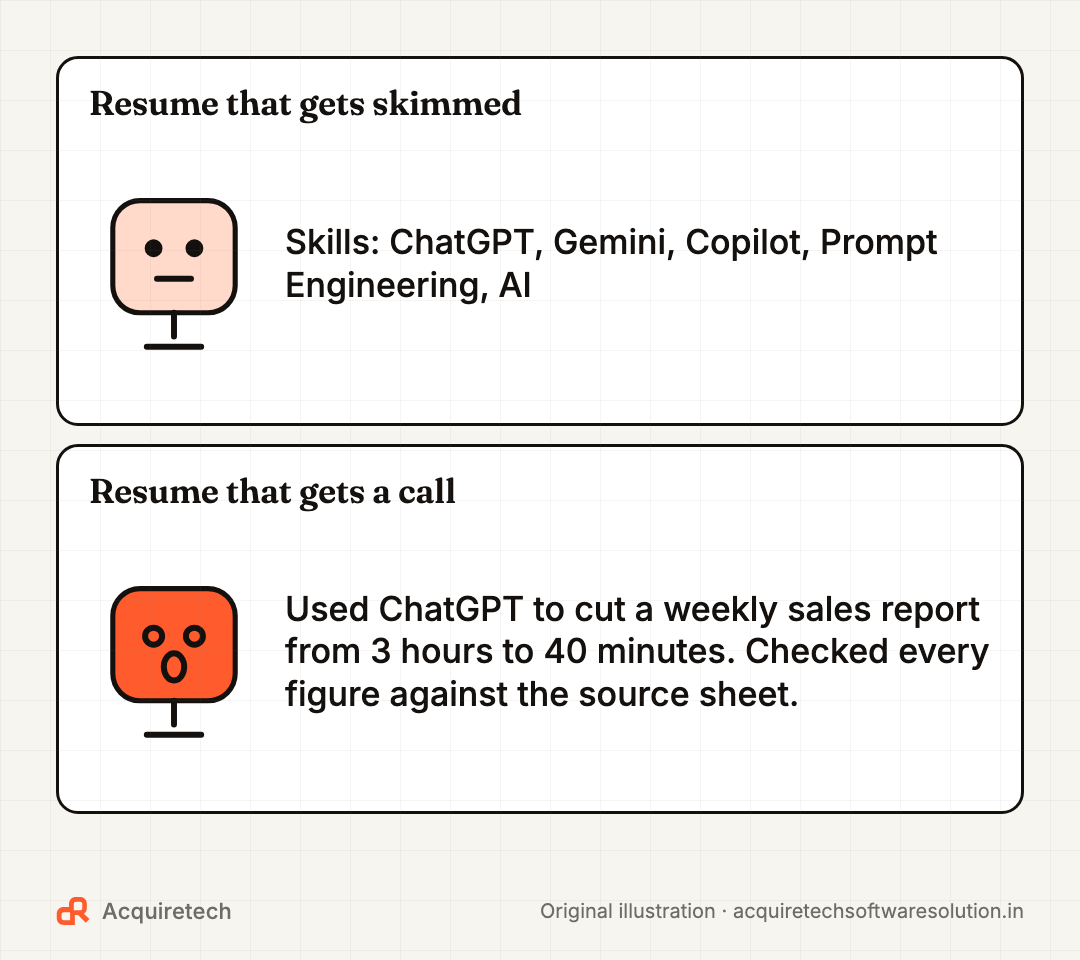
Four examples of resume lines for Indian students. The numbers are placeholders; use your own, real ones:
- B.Com student: "Used Google Sheets formulas and an AI assistant to reconcile 6 months of a family shop's invoices; found ₹X in duplicate payments; verified every flagged entry manually."
- BTech CSE student: "Built a college-notice chatbot that answers from 40 PDF circulars; tested it on 30 questions; it refused to answer the 4 it had no source for."
- BA English / marketing student: "Drafted 12 Instagram captions with AI for a local NGO, rewrote them in the NGO's voice, and tracked which ones got the most saves."
- MBA HR student: "Created an AI-assisted interview question bank for 3 roles; removed questions that tested for irrelevant traits after a peer review."
On a portfolio, give each project a short page: the problem, what you did, the prompt or code, what went wrong, and what you checked. Our guide to a student portfolio website that gets you hired covers the layout, and a final-year project is often your best case study.
Three mistakes to avoid: calling yourself a "prompt engineer" with no work to show, listing a stack of course certificates with no project behind them, and claiming numbers you cannot explain in an interview.
What we know vs what we don't
We know: AI-skill postings and AI literacy demand grew through 2025 and 2026, AI-skilled roles carry a pay premium on average, and employers are pairing AI skills with human judgement.
We don't know: how much of the premium comes from the AI skill itself rather than the kind of role, how hiring for freshers will look in 2027, or whether the WEF's 2030 skills outlook will hold. Those are projections and correlations, not guarantees.
Frequently asked questions
What AI skills are employers looking for in 2026?
Mostly three things: AI literacy (using AI tools well and checking their output), AI-adjacent technical skills such as data, APIs and automation, and human skills like critical thinking and communication. Technical AI engineering is in demand too, but only for builder roles.
Do I need to learn coding to have AI skills?
No. Most roles need AI literacy inside their own tools, plus judgement about the output. Coding matters if you want to build AI products, automations or data pipelines.
Is there a salary premium for AI skills?
PwC's 2026 Global AI Jobs Barometer found an average 62% wage premium in job ads requiring AI skills across 27 countries and territories. It is an average across many roles, so it does not predict any individual offer.
How do I show AI skills on a fresher resume?
Write a line that names the task, the result and how you checked the AI's work, and back it with a portfolio page. Avoid listing tool names on their own.
Are AI certificates worth it for freshers?
A certificate can help you learn, but recruiters weigh proof of work more. Pair any certificate with a small project that shows you applied it.
The bottom line
The AI skill that gets freshers hired in 2026 is not knowing the most tools. It is using AI on real work, catching its mistakes, and explaining what you did. Build one small, honest project in your own field this month and write it up properly.
Next, read how to use AI in your job search without getting binned. If you are looking for a first role, our freshers' guide to remote internships and open roles at Acquiretech are good places to start.
Sources and further reading
- AI reshapes global labour market into two distinct paths, rewarding human skills: PwC 2026 Global AI Jobs Barometer · PwC (via PR Newswire) · 2026-06-15
- LinkedIn data shows where opportunity is emerging as work changes · LinkedIn · 2026-10-27
- AI literacy and change management among most-needed HR skills · HR Dive · 2026-02-27
- January 2026 US Labor Market Update: Jobs Mentioning AI Are Growing Amid Broader Hiring Weakness · Indeed Hiring Lab · 2026-01-22
- 2026 Work Trend Index Annual Report: Agents, human agency, and the opportunity for every organization · Microsoft WorkLab · 2026-05-05
- The Future of Jobs Report 2025 (digest) · World Economic Forum · 2025-01-07
- Analytical thinking remains top core skill for employers · FM Magazine · 2025-02-18
- India well-positioned to become global hub for AI-native talent: Nasscom · The Guardian Chronicle (IANS) · 2026-07-15
Contact Acquiretech Software Solution: info@acquiretechsoftwaresolution.in · WhatsApp +91 80786 33912 · Send an enquiry