Do short videos really wreck your attention? What the research says
A 71-study review links heavy short-video use to weaker attention and more stress. But the link is mostly about compulsive scrolling, not minutes watched. Here is what the evidence supports.
By Shashi Kumar ·
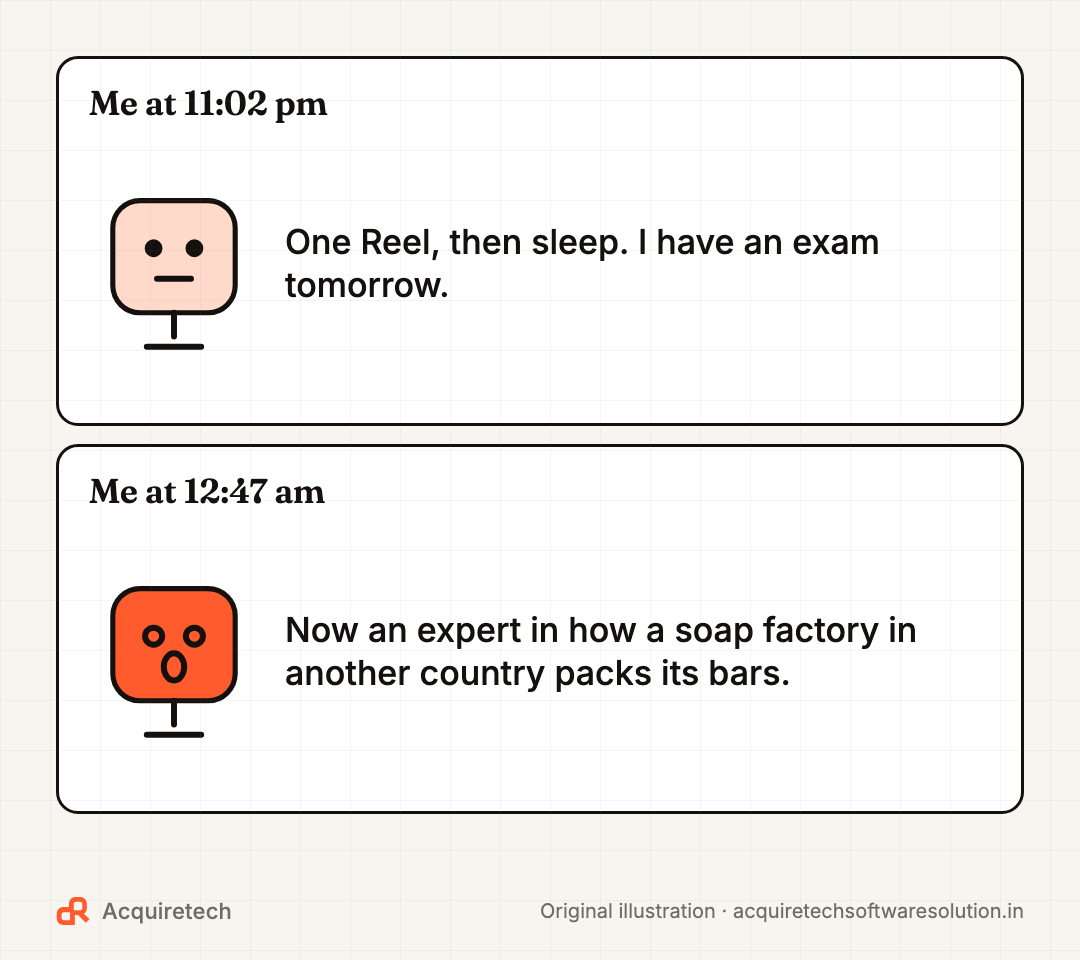
You open Instagram to reply to one message. Forty minutes later you are watching a stranger restore a rusty knife, and you cannot remember what the message was.
Most of us have a version of that story, and there are a lot of us: India had 588 million people watching short videos in 2025, according to the IAMAI–Kantar Internet in India Report 2025, as reported by Manifest Media. That is 61% of the country's internet users.
So is the fear that Reels have wrecked our attention spans backed by science, or is it this decade's version of "television will rot your brain"? The honest answer is more interesting than both slogans.
The short answer
Heavy short-video use is consistently linked with weaker attention, weaker impulse control, more stress and worse sleep. But most of that evidence is correlational. The strongest signal is not how many minutes people watch; it is compulsive use, the "I meant to stop and couldn't" kind. And a few small experiments suggest the effects are at least partly reversible when you cut back.
The biggest review so far: 71 studies, about 98,000 people
In September 2025 the journal Psychological Bulletin published a systematic review and meta-analysis led by Lan Nguyen at Griffith University. It pooled 71 studies with 98,299 participants, covering youth and adults across several short-video platforms.
The headline numbers are correlations (r), where 0 means no relationship and -1 a perfect negative one:
| Outcome | Link with heavier short-video use |
|---|---|
| Cognition overall | r = -0.34 (moderate) |
| Attention | r = -0.38 |
| Inhibitory control | r = -0.41 |
| Mental health overall | r = -0.21 (weak) |
| Stress / anxiety | r = -0.34 / -0.33 |
| Body image, self-esteem | No significant link |
Three details matter more than the headline. First, as Reason's analysis of the paper points out, compulsive use (r = -0.37) and emotional attachment to the apps (r = -0.55) tracked poorer cognition far more closely than time spent watching (r = -0.20). Second, the cognition analysis rested on just 14 studies, all from China, and about three-quarters of all included studies came from Asia. Third, PsyPost's write-up notes that most studies were cross-sectional snapshots relying on self-reported use, and few controlled for social media use in general.
Key point: "Linked with" is not "caused by". People who already struggle with focus or stress may be the ones most drawn to an endless, effortless feed. The arrow could point both ways.
What experiments add (the causation question)
Correlations cannot settle cause and effect, but a few experiments chip away at it.
Short clips and memory
In a paper published in Communications Psychology in 2026, researchers at Yunnan Normal University and Central China Normal University ran three experiments with more than 150 college students, summarised by Phys.org. People learned about travel destinations from either short clips (30 seconds to 2.5 minutes) or a 10-minute video. The short-clip group remembered less accurately and, when told to memorise the content, forgot faster. Brain scans showed less synchronised activity in regions tied to attention and memory.
It is a genuine experiment, but a narrow one: chopped-up clips are a worse way to learn something, which is not the same as scrolling permanently changing your brain.
Turning off mobile internet for two weeks
A randomised trial in *PNAS Nexus* (February 2025) asked 467 US and Canadian iPhone users to block mobile internet for two weeks, keeping calls and texts. Sustained attention on an objective test improved by an amount the authors compare to roughly 10 years of age-related decline, and mental health scores improved too. Caveats: only about a quarter fully complied, and it blocked all mobile internet, not just short videos.
A one-week social media break
A cohort study in *JAMA Network Open* followed 373 US adults aged 18 to 24. The 295 who chose a one-week detox reported anxiety down 16.1%, depression down 24.8% and insomnia down 14.5%. Loneliness did not change, and it was not randomised. Lead author John Torous told the Harvard Gazette that "a digital detox is a very blunt instrument", and that people reacted very differently.
Sleep and mood: the clearest everyday cost
Sleep is where the evidence lines up most neatly. The Psychological Bulletin review found short-video use linked to sleep disturbance, the JAMA detox cut insomnia scores, and the WHO Regional Office for Europe reported in September 2024 that problematic social media use among 11 to 15-year-olds rose from 7% in 2018 to 11% in 2022, and is associated with less sleep and later bedtimes.
The mechanism is simple: a feed with no natural end, consumed in bed, eats sleep, and a tired brain finds the effortless feed even harder to put down.
India's Economic Survey 2025-26, tabled on 29 January 2026, made the same connection, linking short-video compulsion and "endless video loops" to poor sleep, reduced concentration and higher stress, and suggesting age-appropriate defaults and a digital wellness curriculum in schools.
What we know vs what we don't
| We know (fairly well) | We don't know yet |
|---|---|
| Compulsive short-video use tracks with weaker attention and impulse control | Whether normal, moderate use causes lasting harm |
| Short clips are a poorer way to learn and remember new material | How much of the link is reverse causation |
| Cutting back can improve attention and mood within weeks | Whether gains last months later |
| Late-night scrolling and poor sleep travel together | How results transfer to Indian users specifically |
Habits that actually have evidence behind them
- Add friction before opening the app. In a six-week field study in *PNAS*, the one sec app showed a short pause and a "don't open" button whenever 280 users tried to open apps they had chosen. People abandoned 36% of attempts, and openings fell 57% by week six. Moving apps off the home screen works on the same principle.
- Protect the last hour before sleep. Charge the phone outside the bedroom or across the room. This targets the sleep link, the clearest everyday cost.
- Try a two-week experiment, not a lifetime ban. Both break studies above saw changes within one to two weeks.
- Learn from long-form, relax with short-form. The memory experiment suggests clip-learning is the weaker way to study.
- Watch for the emotional hook, not just the clock. Since compulsion and emotional attachment predict problems better than minutes, ask "did I choose this?" rather than only "how long?"
- Replace, do not just remove. In the PNAS Nexus trial, mood gains came with more time offline, more social contact and more sleep.
For parents trying to decode what their children are actually watching, our guide to brainrot and 2026 internet slang helps, and our explainer on AI slop covers why so much of the feed now feels machine-made.
Frequently asked questions
Do short videos reduce attention span?
Heavy, and especially compulsive, short-video use is linked with weaker attention in a 71-study meta-analysis published in Psychological Bulletin in 2025. Most of that evidence is correlational, so it is an association, not proof of cause.
Is watching Reels or Shorts bad for memory?
Experiments published in 2026 found people remembered information less accurately when they learned it from short clips rather than a longer video. That suggests short clips are a weak way to study, but it does not show casual watching permanently damages memory.
Does scrolling short videos at night affect sleep?
Yes, this is one of the most consistent findings. Short-video and problematic social media use are linked to poorer sleep and later bedtimes, and a one-week social media break reduced insomnia scores by 14.5% in a 2025 JAMA Network Open study.
Can attention recover if I cut back?
Early evidence says yes. In a 2025 randomised trial, two weeks without mobile internet improved objectively measured sustained attention and mental health, though compliance was low and longer-term effects are still unknown.
How much short-video watching is too much?
There is no research-backed daily limit. The meta-analysis found compulsive use mattered more than minutes, so a better test is whether you watch on purpose, stop when you intend to, and still sleep well.
The bottom line
Short videos are not secretly shrinking your brain, and anyone claiming that is overselling the data. But the research is clear enough to act on: compulsive scrolling travels with weaker focus, more stress and worse sleep, and small changes help within weeks.
Pick one habit, run it for two weeks, and notice what changes. If you are curious about the other ways your phone shapes your behaviour, read our guide to the WhatsApp privacy settings worth changing today, or see which free AI tools genuinely save time instead of eating it.
Sources and further reading
- Feeds, feelings, and focus: A systematic review and meta-analysis examining the cognitive and mental health correlates of short-form video use (Psychological Bulletin, 151(9), 1125–1146) · American Psychological Association · 2025-09-01
- Large meta-analysis links TikTok and Instagram Reels to poorer cognitive and mental health · PsyPost · 2025-12-18
- Study: Short-Form Video Isn't Rotting Your Brain · Reason · 2025-12-31
- Short videos may hinder learning by fragmenting attention and memory, study finds · Phys.org (on Wei et al., Communications Psychology) · 2026-06-04
- Blocking mobile internet on smartphones improves sustained attention, mental health, and subjective well-being · PNAS Nexus · 2025-02-18
- Social Media Detox and Youth Mental Health (JAMA Network Open) · JAMA Network Open · 2025-11-03
- Social media detox boosts mental health, but nuances stand out · Harvard Gazette · 2025-12-16
- Directing smartphone use through the self-nudge app one sec · PNAS (via PubMed Central) · 2023-02-16
- Teens, screens and mental health · WHO Regional Office for Europe · 2024-09-25
- Tele MANAS: National Tele Mental Health Programme · Ministry of Health and Family Welfare, Government of India · 2026-11-09
- 61% internet users in India consumed short-video content in 2025: Report · Manifest Media (on the IAMAI–Kantar Internet in India Report 2025) · 2026-02-04
- Economic Survey calls for age-based access to online platforms to curb digital addiction · The Tribune (PTI) · 2026-01-29
Contact Acquiretech Software Solution: info@acquiretechsoftwaresolution.in · WhatsApp +91 80786 33912 · Send an enquiry