Will AI take my job? What the 2026 evidence actually says
The best 2026 data shows no wave of mass layoffs from AI, but a clear squeeze on young workers in exposed jobs. Here is what the numbers say, and what to do about it.
By Shashi Kumar ·
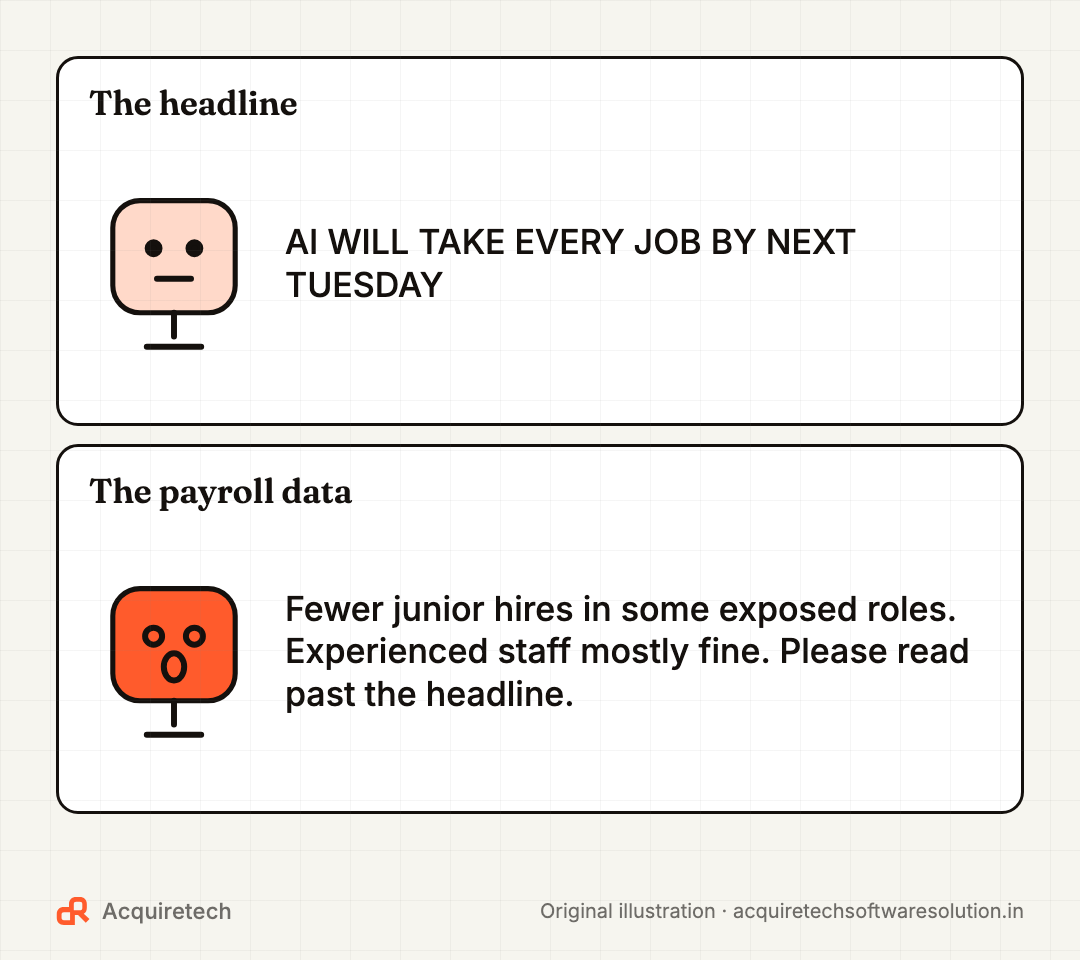
Ask ten people whether AI will take their job and you will get ten confident answers. Ask the payroll data and you get something more boring, and more useful.
Here is the short version as of 9 November 2026: there is no sign of mass, economy-wide job losses from AI yet. But there is a clear, growing squeeze on one group: young people trying to get their first job in roles where AI can do a lot of the work.
That distinction matters, especially if you are a student or fresher in India. Let's look at what the most credible data actually shows, what is projection rather than fact, and what you can do about it.
What the hard data shows
Young workers in exposed jobs are being hired less
The most-cited study is Stanford's "Canaries in the Coal Mine", by Erik Brynjolfsson, Bharat Chandar and Ruyu Chen, which uses ADP payroll records covering millions of US workers. Its August 2026 update found:
- No evidence of widespread, economy-wide job displacement.
- Employment of 22 to 25-year-olds in the most AI-exposed occupations is 19% below where it would be had it kept pace with less-exposed peers. Experienced workers show no comparable gap.
- The gap comes mainly from fewer hires, not more firings.
- Declines cluster where AI substitutes for human tasks. Where AI complements workers, employment is flat or rising.
Stanford's 2026 AI Index points the same way: employment of software developers aged 22 to 25 has fallen nearly 20% since 2024, while their older colleagues' headcount keeps growing. Customer service shows a similar pattern.
Key point: AI is not, so far, firing experienced people en masse. It is quietly removing some of the bottom rungs of the career ladder.
Layoffs that cite AI are real, but smaller than the noise
Outplacement firm Challenger, Gray & Christmas tracks the reasons US employers give for announced job cuts. In its report published on 5 November 2026, AI was cited for 121,401 announced cuts so far in 2026, roughly 20% of the total. But in October, AI was cited for only 1,265 cuts, its lowest monthly figure of the year, and market and economic conditions have overtaken it as the top reason. As Challenger put it, "The reasons employers give have shifted from technology to the economy."
One caution: a company saying AI is behind a cut is not proof that a machine is doing that work now. Sometimes AI is the reason; sometimes it is the more flattering explanation.
Exposure is wide, but exposure is not job loss
Big international bodies measure exposure: how many jobs contain tasks that AI could plausibly do.
- The ILO's 2025 refined index finds about a quarter of jobs worldwide have some exposure to generative AI, but only 3.3% sit in the highest-exposure category. Clerical work is the most exposed, and women are more exposed than men (4.7% of women's jobs in the top category versus 2.4% of men's). The ILO's conclusion: "transformation of jobs is the most likely impact."
- The IMF estimated in January 2024 that almost 40% of global employment is exposed to AI, rising to about 60% in advanced economies, with roughly half of those jobs likely to benefit from productivity gains rather than suffer.
The projections (treat them as projections)
The World Economic Forum's Future of Jobs Report 2025 is a survey of employers' expectations, not a measurement. It projects 170 million jobs created and 92 million displaced by 2030, a net gain of 78 million. In the same survey, 41% of employers plan to reduce staff where AI automates tasks, while 77% plan to upskill their workers. Fastest-declining roles include cashiers, administrative assistants and graphic designers. The biggest growth is projected in frontline and care jobs such as delivery drivers, construction workers and nurses, plus specialist AI, big data and renewable energy roles.
Automated vs augmented: where the data points
Stanford's monthly Canaries dashboard breaks the payroll data down by occupation, and the contrast between roles is striking:
| Customer service | Junior software developers | Clerical and admin | Home health aides | |
|---|---|---|---|---|
| Exposure to AI | High | High | Highest of any occupational group (ILO) | Minimal |
| What the data shows | Noticeable declines for the youngest workers (Stanford payroll data) | Ages 22 to 25 down nearly 20% since 2024 (AI Index 2026) | Admin assistants among the fastest-declining roles to 2030 (WEF projection) | Bigger gains for early-career workers than older ones (Stanford) |
| What it suggests | Routine queries are being automated; complex cases still need people | Entry-level coding is squeezed; experienced developers still in demand | Tasks will change more than jobs vanish, says the ILO | Hands-on care work is growing, not shrinking |
As of 9 Nov 2026. Sources: Stanford Digital Economy Lab (Aug and Oct 2026), Stanford AI Index 2026, ILO (May 2025), WEF Future of Jobs 2025. US payroll data may not translate directly to India.
What about India?
India's IT sector is the obvious worry, because so many first jobs are in entry-level coding, testing and support, exactly the kind of work AI tools are getting good at.
The numbers are mixed rather than catastrophic:
- Industry level: Nasscom estimated the tech industry added about 135,000 people in FY26, up from about 133,000 the year before, Business Today reported. But officials acknowledged campus hiring has dropped significantly from earlier years. Nasscom chairperson Sindhu Gangadharan: "Today, we have technologies that do a big part of the code generation, which means we are moving up the stack."
- Big IT firms: In the July to September 2026 quarter, TCS, Infosys, HCLTech, Wipro and Tech Mahindra together added 13,918 people net, per the Free Press Journal. TCS hired about 10,000 graduates in the quarter, Infosys 8,000 (with a 20,000 target for the year) and HCLTech 6,136 freshers, while Wipro shrank by 6,716. TCS said future recruitment will follow demand, particularly for AI capabilities.
- Job postings: Naukri's JobSpeak index for October 2026 showed AI and machine learning hiring up 32% year on year, while general software and QA roles grew just 1%, Careerindia reported. Some of that growth reflects a festive-season base effect.
Read together: freshers are still being hired, but the mix is shifting. "Can write basic code" is no longer a differentiator. "Can build, test and explain a working system, using AI well" is.
How is AI affecting your work?
How to stay valuable: a practical list
- Own outcomes, not tasks. Tasks get automated; responsibility for whether the result is right does not. Volunteer for the work where someone has to sign off.
- Become the person who checks the AI. Reviewing, testing and correcting AI output is a growing job in itself. Our guide to keeping humans in the loop on AI workflows shows what that looks like in practice.
- Learn to work with agents, not just chatbots. Understanding what AI agents can and can't do is becoming basic workplace literacy.
- Go deeper in a domain. Nasscom says the industry is doubling down on domain knowledge combined with technology skills. A developer who understands lending, logistics or healthcare is much harder to replace than one who only knows syntax.
- Show, don't claim. For students, a portfolio website with real projects beats a list of certificates, and a final-year project you genuinely understand is your best interview story.
- Practise the human parts. Explaining trade-offs, handling an angry customer, negotiating scope: these are where AI is weakest and where junior people can stand out early.
What we know vs what we don't
- We know: young workers in AI-exposed roles are being hired less in US payroll data; experienced workers are mostly unaffected so far; AI-cited layoffs are a real but minority share of cuts.
- We don't know: how much of the entry-level slowdown is AI versus interest rates and post-pandemic over-hiring, how fast this reaches India's services sector, and whether new AI-era roles will absorb the young workers being squeezed out.
Frequently asked questions
Will AI take my job in 2026?
For most people, the 2026 evidence says no. Stanford's payroll study finds no economy-wide displacement, but it does find young workers in AI-exposed occupations are being hired noticeably less than their peers.
Which jobs are most at risk from AI?
Jobs made up largely of routine, screen-based tasks carry the most exposure: clerical and administrative work, customer service, and entry-level coding. Even there, the ILO expects most jobs to be transformed rather than eliminated.
Which jobs are safest from AI?
Roles that combine physical work, care, judgement or face-to-face trust are least exposed so far, such as nursing, home health care, skilled trades and many field jobs. The WEF also projects growth in specialist AI, data and renewable energy roles.
Are Indian IT companies still hiring freshers?
Yes. In the July to September 2026 quarter, TCS hired about 10,000 graduates and Infosys about 8,000. But campus hiring is well below earlier peaks, and companies say they increasingly want AI skills and domain knowledge.
How can I make myself AI-proof?
No job is fully AI-proof, but you can become hard to replace. Learn to use AI tools well, take ownership of outcomes, build deep domain knowledge, and be the person who checks and improves AI output.
The bottom line
AI is not ending work. It is changing who gets the first job and what that job looks like. The people doing best in the data are the ones AI makes better, not the ones it replaces.
If you are a student or early-career developer who likes building real things with AI, have a look at our careers page.
Sources and further reading
- Canaries in the Coal Mine? Six Facts about the Recent Employment Effects of Artificial Intelligence · Stanford Digital Economy Lab · 2026-08-12
- Inside the AI Index: 12 Takeaways from the 2026 Report · Stanford HAI · 2026-04-13
- October Layoffs at Three-Year Low; Seasonal Hiring Plans Up 26% · Challenger, Gray & Christmas · 2026-11-05
- Generative AI and Jobs: A Refined Global Index of Occupational Exposure · International Labour Organization · 2025-05-20
- AI Will Transform the Global Economy. Let's Make Sure It Benefits Humanity · IMF · 2024-01-14
- Future of Jobs Report 2025: 78 Million New Job Opportunities by 2030 but Urgent Upskilling Needed to Prepare Workforces · World Economic Forum · 2025-01-08
- IT industry likely to hire 135,000 employees in FY26, projects Nasscom · Business Today · 2026-02-24
- Indian IT Giants Add 14,000 Employees In Q2 · Free Press Journal · 2026-10-26
- India's Hiring Surge: AI and ML Roles Jump 32%, Here's Where the Jobs Are · Careerindia · 2026-11-03
- Canaries Dashboard · Stanford Digital Economy Lab · 2026-10-21
Contact Acquiretech Software Solution: info@acquiretechsoftwaresolution.in · WhatsApp +91 80786 33912 · Send an enquiry