Google switches Gemini off by default for students: what it means
Google will keep Gemini and Search switched off for school student accounts until admins say yes. Here is what changed, and how to use AI for homework without crossing the line.
By Shashi Kumar ·
For much of 2026, if your child had a school Google account, Gemini was often simply there: one click away from tonight's maths homework.
That is about to change. On 3 November 2026, Google said its AI tools will be switched off by default for K-12 student accounts until a school administrator deliberately turns them on. Search is part of the package too, which is where the story gets messy.
Below: what Google announced, what it means outside the US, and the question every family is arguing about. When is AI help just help, and when is it cheating?
What Google actually announced
In a post titled Designing responsible AI for learning, Chris Phillips, Google's VP and general manager for education, set out the change. The key points:
- Who: K-12 student accounts, meaning school-managed accounts for pupils up to Class 12.
- What: Gemini, Gemini Notebook, Gemini in Classroom and Google Search start in the off position. In Google's words, access "will be entirely off for K-12 student accounts until school administrators explicitly turn them on."
- When: No firm date yet. Google says it will "share more specifics with schools in the coming months ahead of the changes rolling out." AFP reports the controls will start in the US and eventually roll out worldwide.
- Admin controls: After criticism on launch day, Google said schools can switch these services on individually, so a school could allow Search without the Gemini app, according to MediaNama.
- Guided Learning: A step-by-step study mode is now available globally in Google Classroom, and a version inside Search for student accounts starts as a pilot in select US schools later this month.
This reverses August's move, when Google opened Gemini in Classroom to students of all ages, on by default where schools had enabled Gemini.
The Search catch
Here is the part that drew the anger. Search now comes with AI Overviews and AI Mode baked in, and Google offers no student version of Search without them. Phillips told The New York Times that students at schools that disable AI "will not have access to search", as NBC News reported. So schools face a blunt choice: Search with AI, or no Google Search for students at all.
New York City mayor Zohran Mamdani accused Google of "trying to use its monopoly power to force AI into our public schools," AFP reported. Google says the changes "give schools more choice, not less."
Why now?
In October, US senators Josh Hawley and Richard Blumenthal sent Google nine questions about why AI features were on by default for students, with a 2 November deadline, Broadband Breakfast reported. Thirteen parent advocacy groups had also urged districts to switch Gemini off, per NBC. Google's announcement landed the day after the senators' deadline.
What we know vs what we don't
| Question | Status as of 9 November 2026 |
|---|---|
| AI off by default for K-12 student accounts | Confirmed by Google |
| Exact rollout date | Not announced; reported as early 2027 |
| Applies in India | Google says worldwide eventually; no India date |
| Search without AI features | Not offered by Google |
| Personal (non-school) Google accounts | Not covered by this announcement |
That last row matters. A teenager using a personal Google account on a home phone is not affected, which is why habits matter more than any switch an IT admin flips.
Help or cheating? A line you can actually use
Rules differ by school, but one test works almost everywhere:
Key point: If the AI does the thinking the assignment is meant to test, and you hand that in as your own, it is cheating. If the AI helps you do that thinking yourself, it is studying.
A practical way to sort common uses:
| Usually fine | Grey zone: check the rules and disclose | Over the line |
|---|---|---|
| Explaining a concept you missed in class | Brainstorming essay ideas | Submitting AI-written answers as yours |
| Quizzing you before a test | Grammar and style fixes on your draft | AI writing code for a graded assignment you can't explain |
| Checking your working after you've solved it | Summarising sources you then read | Using AI in a closed-book test or exam |
In the grey zone, read your course's AI policy; when in doubt, ask, then say what you used.
How to use AI as a tutor, not a ghostwriter
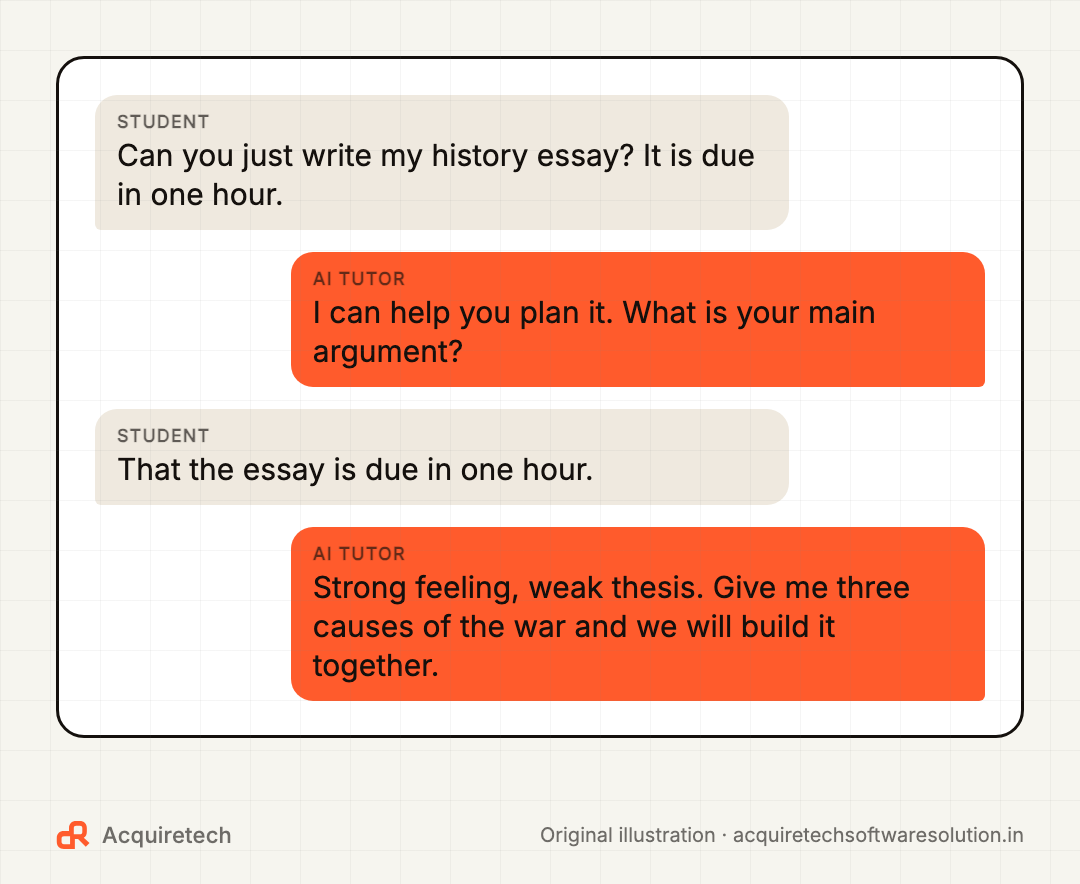
Google's Guided Learning is built on one idea: walk students through a problem instead of handing over the answer. You can do the same with any assistant today:
- Explain it differently: "Explain photosynthesis to me as if I am in Class 7, then ask me one question to check I understood."
- Quiz me: "Give me five questions on quadratic equations, one at a time. Don't show answers until I reply."
- Check my reasoning: "Here is my solution. Don't solve it for me. Tell me the first line where my logic goes wrong."
- Hint ladder: "Give me the smallest possible hint. If I'm still stuck, give a bigger one."
You stay in the driver's seat. For more patterns, our prompt-writing cheat sheet has templates that work across assistants, and our ChatGPT vs Gemini vs Claude comparison covers which one suits which kind of task.
What schools and universities say
Students are well ahead of the rulebooks. Stanford's 2026 AI Index found four out of five US high school and college students use AI for schoolwork, yet only about half of middle and high schools have AI policies, and just 6% of teachers say their school's policies are clear.
In India, CBSE is teaching AI rather than policing it: its Computational Thinking and AI curriculum for Classes 3 to 8 starts in the 2026-27 session, while homework rules are left to schools. At college level, the UGC's 2018 academic integrity and plagiarism regulations apply to anything you submit, and universities are adding their own AI guidance. In the UK, the Russell Group's principles on generative AI commit its universities both to building AI literacy and to ensuring "academic rigour and integrity is upheld."
The common thread: AI use is increasingly allowed, but undisclosed use is where students get into trouble.
For engineering and computer science students
If AI wrote code you can't explain in a viva, you have a problem whatever the policy says. Our guide to final-year project help for BTech, MCA and BCA students covers getting support while keeping the work yours. And a student portfolio website that shows your process, not just polished output, is the best proof you didn't outsource your skills.
Privacy for minors: what parents should know
School accounts and personal accounts are treated differently. For school accounts, Google's Classroom help page says the student Gemini tab offers "enterprise-grade privacy and security, where data is not reviewed by humans or used to train AI models." Personal accounts run under consumer terms, which are not the same thing.
In India, the Digital Personal Data Protection Rules, notified on 14 November 2025, require services to get verifiable parental consent before processing data of anyone under 18, with the main obligations phasing in after 18 months, Biometric Update reported. Schools get limited exemptions for educational activities.
Two family rules: know whether your child uses a school or personal account for AI, and never paste names, phone numbers, Aadhaar details or classmates' photos into a chatbot.
Quick quiz: help or cheating?
Frequently asked questions
Is Google turning off Gemini for all students?
No. The change applies to K-12 student accounts managed by schools, and those services stay off only until a school administrator turns them on. Personal Google accounts are not covered by the announcement.
When will the Gemini default change happen?
Google has not given a date. Its 3 November 2026 post says it will share specifics with schools in the coming months, and reports suggest early 2027, starting in the US.
Will this apply to schools in India?
AFP reports the controls will eventually roll out worldwide, but as of 9 November 2026 Google has not announced an India timeline.
Is it cheating to use AI for homework?
Not automatically. Using AI to explain, quiz or check your own work is generally studying; submitting AI-generated work as your own is cheating. Rules vary, so check your school's policy.
Is my child's data used to train Google's AI models?
For school accounts, Google says data in the student Gemini tab in Classroom is not reviewed by humans or used to train AI models. Personal accounts follow different consumer terms.
The bottom line
Google's switch hands the decision back to schools, with a Search condition many think is unfair. Whatever your school decides, the lasting skill is the same: use AI to understand faster, not to skip the understanding.
If AI is changing how you think about your future career, our look at what the 2026 evidence says about AI and jobs is a good next read.
Sources and further reading
- Designing responsible AI for learning · Google · 2026-11-03
- Google to shut off search for schools that opt out of AI · NBC News · 2026-11-03
- Google turns off AI for schoolchildren by default · France 24 (AFP) · 2026-11-04
- Google lets schools switch off Gemini, but AI in Search is all or nothing · MediaNama · 2026-11-04
- Hawley, Blumenthal Press Google on AI Risks in Schools · Broadband Breakfast · 2026-10-28
- Inside the AI Index: 12 Takeaways from the 2026 Report · Stanford HAI · 2026-04-13
- Learn about Gemini in Google Classroom · Google Classroom Help · 2026-11-09
- Computational Thinking and Artificial Intelligence (CT&AI) · CBSE Academic · 2026-11-09
- Principles on the use of generative AI tools in education · Russell Group · 2023-07-03
- India notifies its sweeping digital personal data protection rules · Biometric Update · 2025-11-14
Contact Acquiretech Software Solution: info@acquiretechsoftwaresolution.in · WhatsApp +91 80786 33912 · Send an enquiry